Generative engine optimization (GEO) is the practice of structuring your website and online presence so AI answer engines such as ChatGPT, Gemini, Perplexity and Google AI Overviews understand, trust and cite your business when people ask questions. For a small service business, generative engine optimization turns AI search into a new source of high-value leads: the buyer asks an AI assistant who to hire, and your name is in the answer.
I am Rajeeb Mookhopadhyay, a business growth consultant at rajeebm.pro, and I have spent more than 20 years helping businesses get found online. This guide explains generative engine optimization in plain English, shows how it differs from classic SEO, and gives you seven tactics you can apply this month.

Table of Contents
- What Is Generative Engine Optimization (GEO)?
- Generative Engine Optimization vs SEO
- 7 Generative Engine Optimization Tactics That Win Leads
- How GEO Drives High-Value Leads
- AI Search Optimization by Industry
- A 30-Day Generative Engine Optimization Plan
- When GEO Is Not Your First Priority
- Generative Engine Optimization Services: DIY or Done for You?
- Further Reading and Resources
- Frequently Asked Questions
What Is Generative Engine Optimization (GEO)?
What is generative engine optimization?
Generative engine optimization is the process of making your content easy for large language models to find, understand and quote, so your business appears inside AI-generated answers rather than only in a list of blue links.
Traditional SEO aims for a ranking position. GEO aims for a citation. When someone asks “Who is the best family dentist near Bondi?” or “Which recruitment agency places welders in Germany?”, the AI writes one answer and names a handful of sources. Generative engine optimization is how you become one of those sources.
Why does generative engine optimization matter in 2026?
Generative engine optimization matters because a growing share of buying research now starts in AI assistants instead of a search results page.
Gartner predicted that traditional search engine volume will drop 25% by 2026 as people shift to AI chatbots and virtual agents (Gartner, 2024). Google itself now shows AI Overviews above organic results for many queries. If your business is invisible to these systems, you lose the enquiry before a visitor ever reaches your website.
How do AI answer engines choose which businesses to cite?
AI answer engines cite sources that clearly answer the question, appear consistent across the web and look trustworthy.
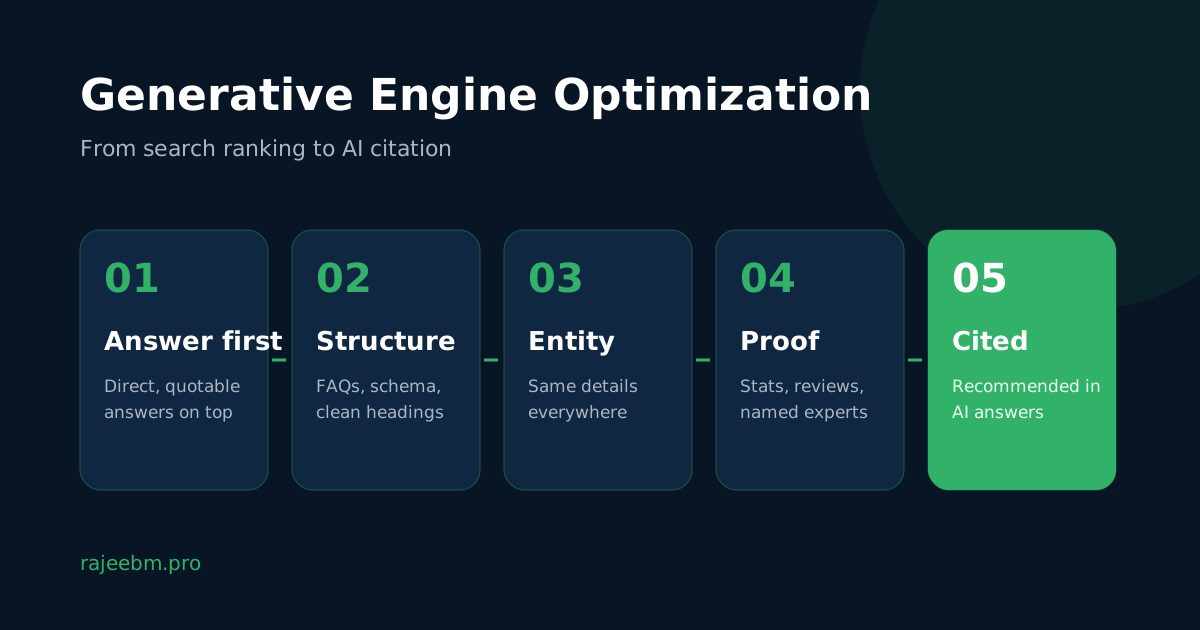
In practice that means pages with direct answers near the top, clean structure, named experts, specific numbers, and the same business details repeated on your website, your Google Business Profile and trusted directories. Answer engine optimization and generative engine optimization overlap heavily here: both reward content that a machine can lift and quote without rewriting it.
Generative Engine Optimization vs SEO: What Actually Changes
Generative engine optimization does not replace SEO. It builds on it. Google still crawls and indexes your pages, and most AI assistants lean on search indexes to find sources. What changes is the goal, the format of winning content and the way you measure success.
| Factor | Classic SEO | Generative Engine Optimization (GEO) |
|---|---|---|
| Main goal | Rank on page one | Be cited inside the AI answer |
| Winning format | Keyword-focused pages | Direct answers, FAQs, tables, named facts |
| Trust signals | Backlinks, authority | Consistent entity data, expert authorship, citations |
| Typical query | “dentist Bondi” | “Which Bondi dentist is best for nervous patients?” |
| How you measure it | Rankings, clicks | AI mentions, branded searches, lead quality |
The practical takeaway: keep doing solid SEO, then layer generative engine optimization on top so the same pages also work as quotable answers. AI search optimization is less about tricks and more about clarity.
7 Generative Engine Optimization Tactics That Win Leads
These are the generative engine optimization tactics I apply first for small service businesses. They are ordered by impact for the effort involved, so start at the top.
1. Lead every page with a direct answer
Open each service page and article with one or two sentences that answer the main question completely. AI models favour passages they can quote without context.
For example, a law firm page should start with “We handle employment disputes for small businesses in Ontario, with fixed-fee initial consultations” rather than a paragraph about the firm’s values. That single change often does more for answer engine optimization than any technical tweak.
2. Build real FAQ sections with structured data
Add FAQ sections that answer the questions customers actually ask, then mark them up with FAQ structured data so machines understand the question-and-answer format.
Use the wording customers use on calls and in emails, not internal jargon. Google documents how its systems read structured data in Google Search Central, and the same clarity helps every AI search optimization effort.
3. Make your business entity consistent everywhere
Generative engine optimization depends on AI systems being confident about who you are. Your business name, address, phone, services and service area should match on your website, Google Business Profile, LinkedIn and key directories.
Inconsistent details create doubt, and doubtful sources are rarely cited. Add an About page with a named expert, credentials and years of experience, because AI models look for evidence of real expertise.
4. Use specific numbers, sources and examples
Vague claims like “fast service” give an AI nothing to quote. Specific statements like “most emergency call-outs are attended within 90 minutes in central Leeds” do.
Research from Princeton and Georgia Tech found that GEO methods such as adding statistics, quotations and cited sources can boost a source’s visibility in generative engine responses by up to 40% (Aggarwal et al., 2023). Only publish numbers you can stand behind.
5. Earn mentions on sites AI already trusts
AI answer engines cross-check you against the wider web. Reviews on Google, mentions in local news, industry associations and trusted directories all strengthen your generative engine optimization.
Ask happy clients for detailed reviews that mention the service and location. A review that says “they fixed our boiler on a Sunday in Croydon” is far more useful to an AI than “great service”.
6. Keep your site fast, crawlable and readable by AI
If AI crawlers cannot load or parse your pages, nothing else matters. Use a fast, mobile-friendly website, clean HTML headings, a sitemap and sensible robots rules.
Speed still matters to humans too: Google research found 53% of mobile visits are abandoned when a page takes longer than three seconds to load (Google, 2017). Some businesses also publish an llms.txt file that summarises key pages for language models; it is optional, but cheap to add.
7. Measure AI visibility, not just rankings
Track how often AI assistants mention your business for your core questions. Ask ChatGPT, Gemini and Perplexity the questions your customers ask, every month, and record who gets named.
Also watch branded searches and the “How did you hear about us?” answers on your enquiry form. Generative engine optimization often shows up as more people searching for your name directly, which is a strong sign the AI is recommending you.
How Generative Engine Optimization Drives High-Value Leads
Generative engine optimization attracts better leads, not just more leads. Someone who asks an AI a detailed question, reads a recommendation and then contacts you has already done their research. They usually arrive with a clear need and a higher intent to buy.
Why are AI-referred leads often higher value?
AI-referred leads are often higher value because the AI has already filtered options against the buyer’s specific needs before recommending you.
A prospect who asks “Which immigration lawyer in Dubai handles investor visas for tech founders?” and gets your name is pre-qualified in a way a generic search visitor is not. That is why GEO suits firms with high-ticket services: consultants, law firms, clinics and B2B providers.
How to rank in ChatGPT and Google AI Overviews for local services
To rank in ChatGPT and AI Overviews for local services, combine a strong Google Business Profile, location-specific service pages and FAQ content that names your city and service area.
- Create one page per core service and location you genuinely serve.
- Answer the top five customer questions on each page.
- Collect reviews that mention the service and suburb or city.
- Keep your business details identical across every listing.
- Re-test the same prompts in AI assistants every month.
Speed of response still decides who wins the lead
Visibility only helps if you respond quickly. A Harvard Business Review study found firms that contacted leads within an hour were nearly seven times as likely to qualify them as firms that waited even one hour longer (Harvard Business Review, 2011).
That is why generative engine optimization works best alongside an AI receptionist and chatbot that answer every enquiry instantly. Getting cited is step one; answering in seconds is how you win the client.
AI Search Optimization by Industry
Every sector asks AI different questions, so AI search optimization should be tuned to how your buyers think. Here is where I focus first for the industries I work with most.
| Industry | Typical AI question | GEO priority |
|---|---|---|
| Dental and medical clinics | “Best clinic for Invisalign near me?” | Treatment FAQs, reviews, clinician profiles |
| Law firms | “Which firm handles small business contract disputes?” | Practice-area pages, lawyer credentials |
| Recruitment agencies | “Agency that supplies skilled welders to the EU?” | Sector pages, compliance details, case examples |
| Trades and handyman services | “Emergency plumber open Sunday in Auckland?” | Google profile, hours, service-area pages |
| Consultants and B2B | “Who helps startups automate lead generation?” | Expert articles, named methods, testimonials |
Across all of them, the generative engine optimization pattern is the same: answer the real question clearly, prove expertise, and stay consistent everywhere your business is listed.
A 30-Day Generative Engine Optimization Plan
If you want a simple starting point, this 30-day generative engine optimization plan covers the highest-impact work for a small service business.
- Week 1: ask ChatGPT, Gemini and Perplexity your top ten customer questions and record who gets cited. This is your baseline.
- Week 2: rewrite the opening of your five most important pages so each starts with a direct, quotable answer.
- Week 3: add an FAQ section with structured data to each of those pages, and make your business details identical across every listing.
- Week 4: request reviews from recent happy clients, fix any slow pages, then repeat the Week 1 prompts and compare.
Repeat the cycle monthly. Generative engine optimization compounds: each clear answer you publish becomes another chance to be cited.
When Generative Engine Optimization Is Not Your First Priority
Generative engine optimization is powerful, but it is not always the first thing to fix. Be honest about where your business is today.
- No website or a broken one: fix the foundations first; AI cannot cite a page that does not load.
- Missed calls and slow replies: if enquiries already go unanswered, more visibility only means more lost leads. Fix response speed first.
- Very low-ticket, impulse services: paid ads and marketplaces may deliver faster returns than GEO.
- No reviews or proof yet: collect a handful of genuine reviews before expecting AI to recommend you.
For most established service businesses, though, GEO is now part of good marketing hygiene rather than an optional extra.
Generative Engine Optimization Services: DIY or Done for You?
You can start generative engine optimization yourself with the seven tactics above. Many owners do the basics well: a clear FAQ, a complete Google profile and consistent listings.
Where done-for-you generative engine optimization services help is the joined-up work: rewriting service pages as quotable answers, adding structured data, fixing site speed, building location pages and tracking AI mentions month by month. At Rajeeb M (rajeebm.pro) we include this as the Next-Gen SEO pillar of our 10-pillar growth system, built for businesses in the US, Canada, UK, EU, Australia, New Zealand and the UAE.
| Approach | Best for | Typical effort |
|---|---|---|
| DIY GEO | Small sites, owners with time to write | A few hours per week, ongoing |
| Freelancer | One-off content or technical fixes | You manage the plan |
| Done-for-you (Rajeeb M) | Owners who want GEO, website and lead handling joined up | Built and demoed first, no upfront cost |
Our model is simple: we build and show your improvements working before you pay anything. If generative engine optimization is not the right lever for your business yet, we will tell you on the call.
Further Reading and Resources
- Google Search Central: AI features and your website
- GEO: Generative Engine Optimization (research paper)
- Schema.org FAQPage specification
- How an AI receptionist answers every lead 24/7
- Lead generation for small business by industry
Frequently Asked Questions
What is generative engine optimization in simple terms?
Generative engine optimization is making your website easy for AI assistants like ChatGPT and Google AI Overviews to understand and quote, so they recommend your business in their answers.
It uses clear answers, FAQs, structured data and consistent business details. Think of it as SEO written for machines that summarise rather than list.
Is GEO the same as SEO?
No, GEO builds on SEO: SEO helps you rank in search results, while GEO helps you get cited inside AI-generated answers that often appear above those results.
You still need crawlable pages, speed and authority. GEO adds answer-first writing, entity consistency and AI visibility tracking.
What is the difference between answer engine optimization and generative engine optimization?
Answer engine optimization targets direct answers such as featured snippets and voice results, while generative engine optimization targets citations in AI-written responses from large language models.
The tactics overlap heavily, so one well-structured page usually serves both. Most businesses treat them as a single AI search optimization effort.
How long does generative engine optimization take to show results?
Most businesses see early signs of generative engine optimization working within two to four months, once AI systems recrawl updated pages and new reviews accumulate.
Results build over time, like SEO. Quick wins come from fixing your Google profile and adding clear FAQ answers.
Can a small business compete with big brands in AI search?
Yes, small businesses often win local and specialist AI answers because they can be more specific and consistent about a service and location than large brands.
A clinic that clearly answers “Invisalign for adults in Parramatta” can be cited ahead of a national chain with a generic page.
How much do generative engine optimization services cost?
Generative engine optimization services usually cost less than a full SEO retainer when combined with existing website work, and at Rajeeb M there is no upfront cost because we build first and you pay after approving results.
Pricing depends on site size, number of locations and content needed. You get a custom quote after a free strategy call.
Is GEO worth it if I already rank well on Google?
Yes, because AI Overviews and assistants increasingly answer the question before people click, so ranking well no longer guarantees the visit.
Adding GEO protects the traffic you have earned and turns your existing authority into AI citations.
Want ChatGPT and Google AI to recommend your business?
We audit your AI visibility, rebuild your key pages for generative engine optimization and show you the results before you pay a cent.
👉 Book your free strategy call →

About the author: Rajeeb Mookhopadhyay is a business growth consultant with 20+ years of experience, a B.Com (Honours), an MBA in Marketing and Google certifications in digital marketing and Google Ads. He builds websites, AI receptionists, SEO and automation for small businesses. Read more about Rajeeb.