A real estate investor website has to do two jobs: earn the trust of a property owner who may be under stress, and turn that visit into a lead the investor can act on quickly. This case study shows how I built a 20-page real estate investor website and a custom CRM for Imperial Property Services, a licensed California brokerage that buys houses and land across the USA.
I am Rajeeb Mookhopadhyay, a business growth consultant at Rajeeb M (rajeebm.pro). I have worked with business owners since 2004. Imperial Property Services is owned and led by Subodh Banerjee, a California licensed real estate broker (CalDRE #01804026), and he agreed to let me share this project. Below you will see what we built, why each part is there, the costly mistakes we avoided, and what is still in progress. There are no invented numbers here: where results are not in yet, I say so.
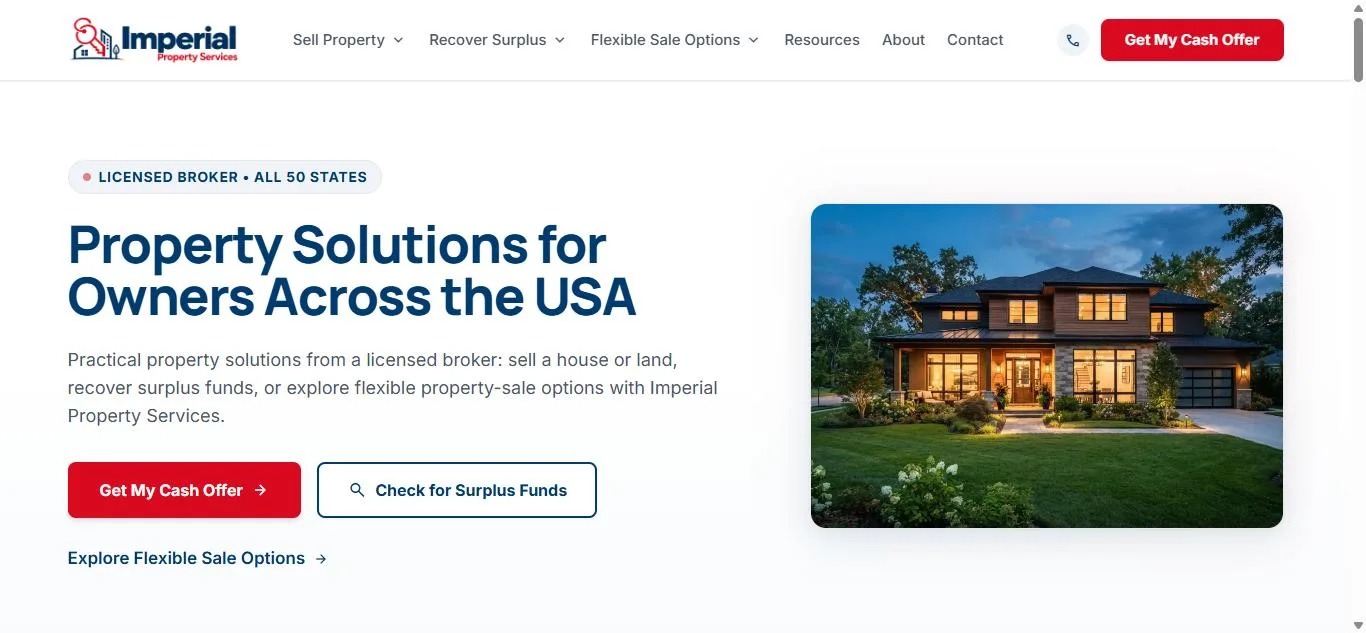
Table of Contents
- The Client: Imperial Property Services
- What Is a Real Estate Investor Website?
- The Real Estate Investor Website We Built: 20 Pages
- SEO and Speed: How Every Page Scored 91 to 96
- The Real Estate Investor CRM Behind the Website
- 5 Costly Mistakes on Real Estate Investor Websites
- Where the Project Stands Today
- When a Website Alone Is Not Enough
- How I Build Projects Like This at Rajeeb M
- Further Reading and Resources
- Frequently Asked Questions
The Client: Imperial Property Services
Imperial Property Services is a real estate business based in San Jose, California. It works with property owners across the United States and offers several ways to sell or recover money from a property:
- buying houses and vacant land for cash
- surplus funds recovery after a foreclosure or tax sale
- creative financing, seller financing and subject-to options
Subodh came to me with a clear brief. He wanted a premium look, a site that a stressed homeowner could understand in a few seconds, and content that stays careful about legal and financial claims. He also asked for a system behind the website that could handle land leads from the first list import to the last monthly payment.
What did the client need from the project?
The client needed a trustworthy real estate investor website that explains each selling situation clearly, plus a CRM that captures every lead and manages the deal without extra staff.
In plain terms: one place where sellers find answers, and one place where Subodh and his team see every lead, every call and every offer.
What Is a Real Estate Investor Website?
What is a real estate investor website?
A real estate investor website is a site built to attract property owners who want to sell, explain the investor’s options in plain language and collect the property details needed to make an offer.
It is different from an agent’s listing website. An agent’s site shows homes for sale to buyers. A real estate investor website speaks to sellers first: people dealing with inherited houses, tenants, low equity, foreclosure or land they no longer want.
Why does a real estate investor website need to build trust first?
A real estate investor website needs to build trust first because many sellers are worried about scams, and “is we buy houses legit” is one of the top questions Google suggests when people search this topic.
That is why the Imperial site shows the owner’s name and license number near the top of key pages, links to official sources and avoids promises it cannot keep.
How is a we buy houses website different from a normal business site?
A we buy houses website is different because each visitor arrives with a specific problem, so it needs one clear page per situation, a short property form and fast follow-up, rather than a single generic services page.
Buyers are online too, which matters when the investor resells land. According to the National Association of Realtors, 52% of buyers found their home online and 70% used mobile or tablet devices during their search (NAR Profile of Home Buyers and Sellers, 2025). A site that is slow or hard to use on a phone loses both sides of the deal.
The Real Estate Investor Website We Built: 20 Pages
The website lives at imperialprop.us. It runs on WordPress with Elementor Pro and the Astra theme. Subodh asked to keep the pages as hand-written HTML and CSS (Tailwind) inside Elementor, so each page is one clean block of code that I control line by line.
Instead of one “we buy houses” page, this real estate investor website has one page for each situation a seller may be in. This is the structure:
| Seller situation | Page on the website |
|---|---|
| Wants a quick cash sale | Sell Your House Fast, Sell Your Land Fast |
| Difficult property | Inherited House, Distressed Property, House With Tenants, Low Equity |
| Facing foreclosure | Sell House Before Foreclosure |
| Money left after a sale | Surplus Funds Recovery, Foreclosure Surplus Funds, Tax Sale Excess Proceeds |
| Wants more than a cash price | Creative Financing, Seller Financing, Subject-To Real Estate |
| Still comparing options | Resources, Cash Buyer vs. Traditional Listing |
| Wants to know who they deal with | Home, About, Contact, Privacy Policy, Terms of Service |
Lead forms that ask only what is needed
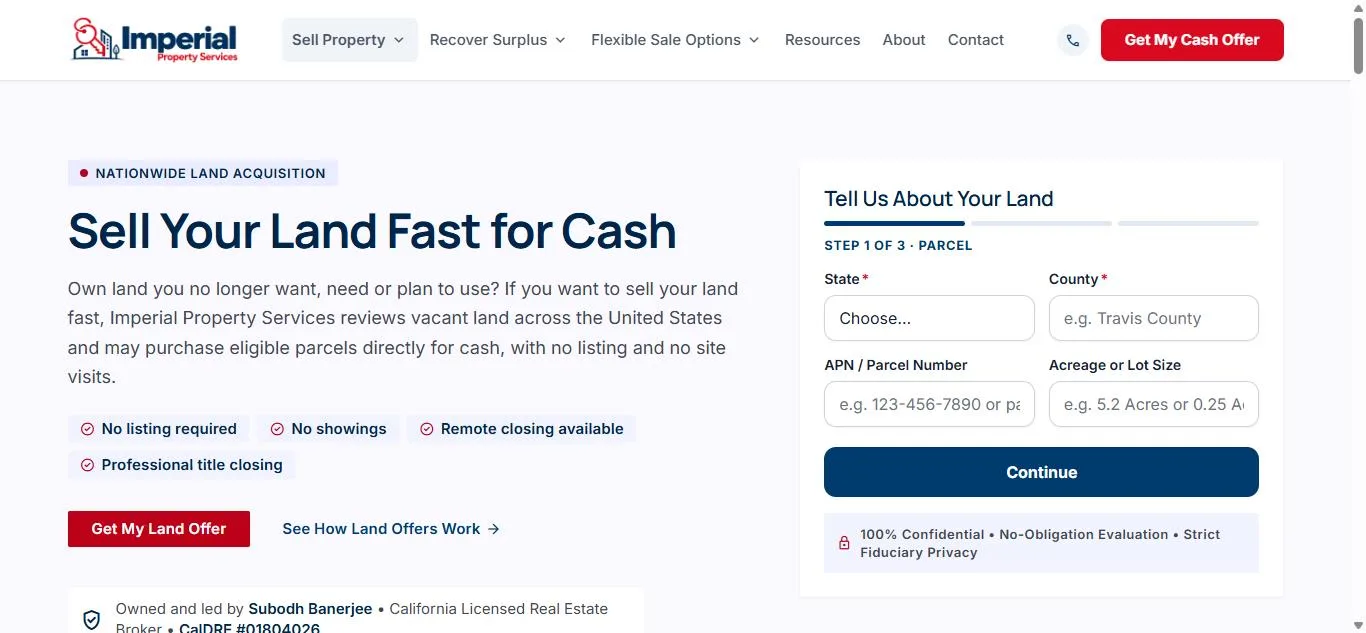
Every selling and recovery page has a short form (15 of the 20 pages, including Contact). The land form, for example, works in three steps: state and county, parcel number and acreage, then contact details. Small steps feel easier than one long form, and the parcel number lets the team check the land before anyone calls the owner.
The forms come from the CRM itself. When Subodh changes a question in the CRM, the form on the website updates by itself, and every submission lands in the CRM as a website lead.
Compliance-careful writing
Real estate content can get a business into trouble if it overpromises. On this real estate investor website, the copy uses “may” language (Imperial “may purchase eligible parcels”), never guarantees an offer or a result, recommends speaking to an attorney or tax professional where it matters, and links to official government sources. The owner’s California license can be checked by anyone on the California Department of Real Estate license lookup.
SEO and Speed: How Every Page Scored 91 to 96
A real estate investor website only brings sellers if Google can understand it. On 9 October 2026 I finished an SEO pass on all 20 pages. Each page got its own focus keyword (for example “sell your land fast” or “foreclosure surplus funds”), an SEO title, a meta description under 160 characters, internal links and a section of images with descriptive alt text.
I checked every page with Rank Math’s own scoring code, the same analyzer the plugin uses inside WordPress. All 20 pages scored between 91 and 96 out of 100.
| What we did | Why it matters |
|---|---|
| One focus keyword per page, mapped before writing | Pages do not compete with each other in Google |
| Rank Math scores of 91 to 96 on all 20 pages | The basics (titles, headings, links, images) are all in place |
| Photos resized to 1,200px and served as WebP | Faster pages, especially on mobile data |
| Tailwind loaded as one pre-built CSS file instead of the live CDN script | No styling delay; checked on 20 pages at 2 screen widths with 0 visual changes |
| Unused WordPress scripts removed (emoji script, jQuery Migrate) | Less code for the browser to load |
| RealEstateAgent schema with address, phone and logo | Google can connect the site to a real, licensed business |
A good score gives a real estate investor website a solid base, but it is not a ranking. Google’s own guidance says it rewards helpful, reliable, people-first content, so the pages answer real seller questions in plain English instead of repeating keywords. If you want to see how I approach SEO for other small businesses, read my page on SEO services for small business.
The Real Estate Investor CRM Behind the Website
A real estate investor website collects leads. What happens next decides whether those leads turn into deals. For Imperial I built a custom real estate investor CRM, called Imperial Property CRM, instead of forcing the business into an off-the-shelf tool.
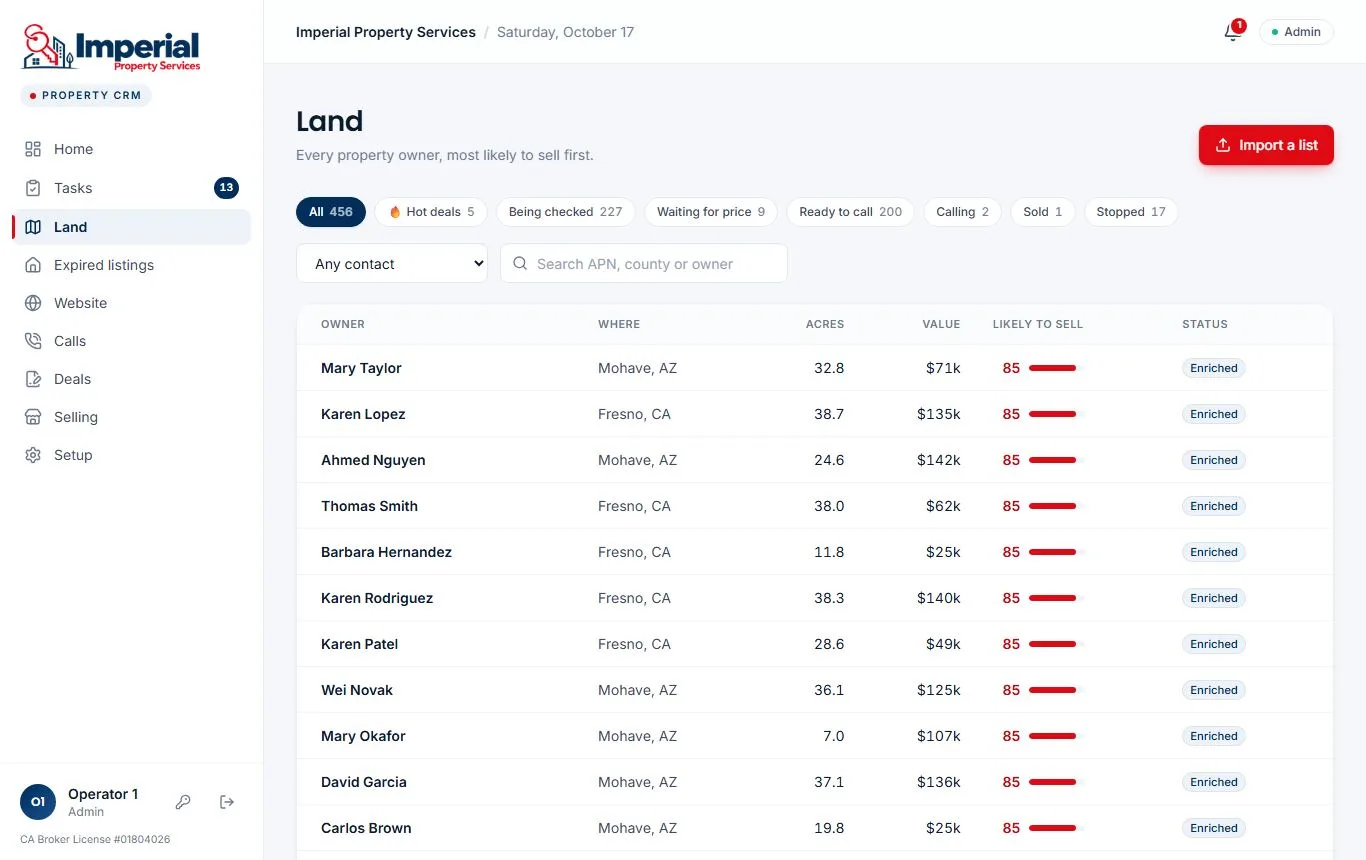
Module 1 covers vacant land flipping and seller financing, from start to finish:
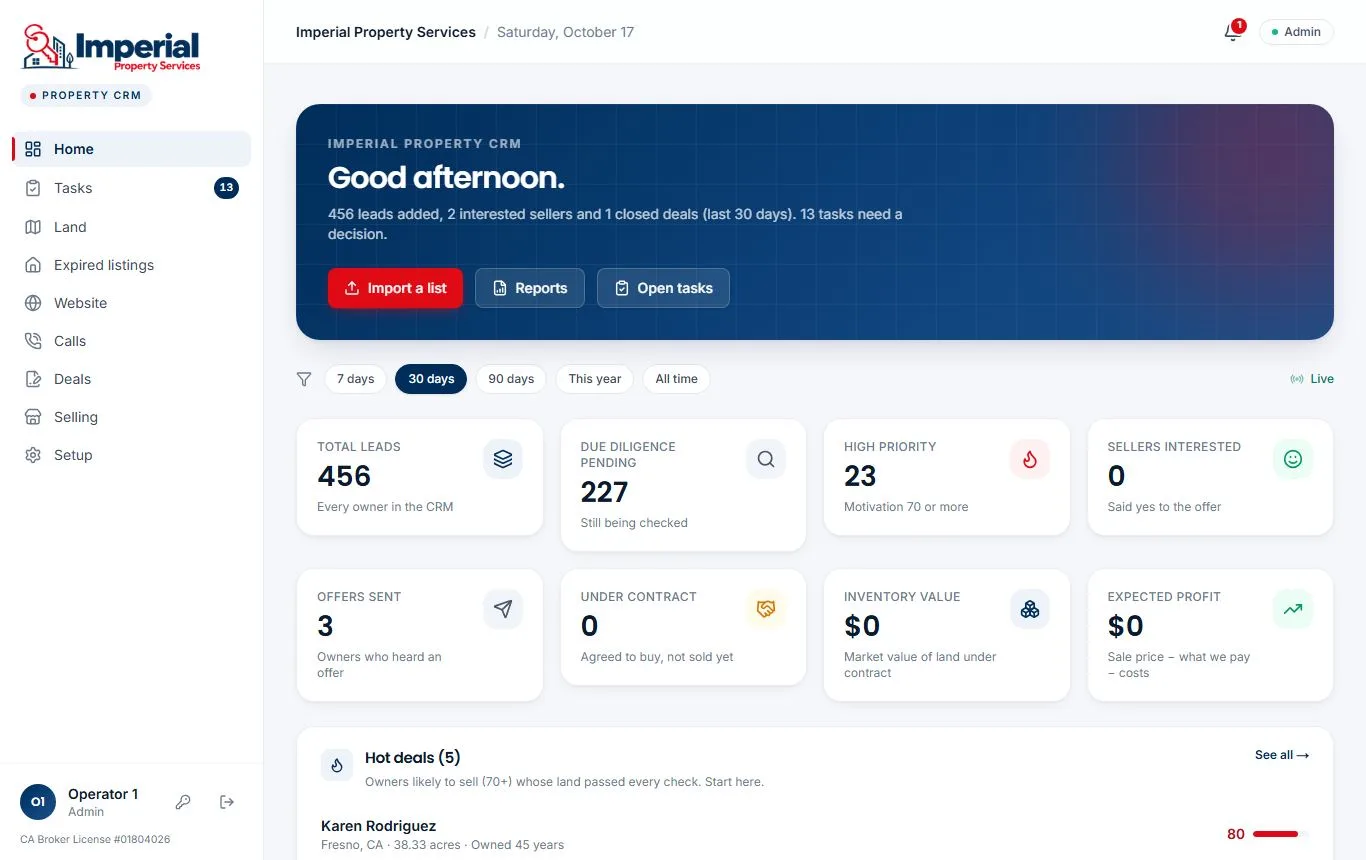
The dashboard and lead list shown here use the CRM’s built-in test data, not real sellers or real results.
| CRM step | What it does for the owner |
|---|---|
| Import a list | Loads owner lists (such as PropertyRadar exports); in testing, 250 leads imported in about 6 seconds with no duplicates |
| AI due diligence and pricing | Checks each parcel and suggests a price, then ranks owners by how likely they are to sell |
| AI calling with compliance checks | Calls only numbers that pass the rules; blocks Do-Not-Call, opted-out, after-hours and no-consent numbers, and plays the recording notice first |
| Offers approved by the owner | Every offer waits for Subodh’s approval; nothing goes out on its own |
| Built-in e-sign and closing | Purchase contracts are signed inside the CRM and tracked to closing |
| Selling and payment plans | Creates property pages for buyers and manages monthly payment plans for seller-financed land |
What is a CRM in real estate?
A CRM in real estate is the system that stores every lead, call, offer and deal in one place, so nothing depends on memory, sticky notes or a spreadsheet.
For an investor, it also needs to handle tasks an agent CRM does not: parcel research, offer pricing, purchase contracts and, for seller financing, collecting payments after the sale.
Why build a custom real estate investor CRM?
A custom real estate investor CRM makes sense when the business has its own process, such as land flipping with seller financing, that general tools only cover with add-ons and manual work.
Subodh also wanted minimal screens and very short reports in plain English. A custom build let us design every screen around his day instead of the other way around.
Security and reliability
The CRM handles contracts, ID documents and owner data, so security was part of the build from day one:
- contracts and ID files are encrypted, and download links expire after 15 minutes
- every change is logged permanently
- a virtual assistant can work leads without seeing owner details
- nightly encrypted backups are kept for 30 days, with an automatic restore test every month
- 280 automatic tests run against the system
In testing, the dashboard opens in about a quarter of a second with 10,000 leads loaded.
Fast follow-up is where many investors lose deals. I have written more about this in speed to lead and missed call text back.
5 Costly Mistakes on Real Estate Investor Websites
These are the mistakes I see most often when I review a real estate investor website, and how we handled each one for Imperial.
1. One generic page for every seller
A single “we buy houses” page cannot speak to a widow selling an inherited house and a landlord with problem tenants at the same time. Imperial has a dedicated page for each situation, so the visitor sees their own problem in the headline.
2. Promises the business cannot keep
“Guaranteed offer in 24 hours” or “we pay top dollar” may bring clicks, but it also brings complaints and legal risk. The Imperial real estate investor website uses careful language and points sellers to professional advice.
3. Forms that go nowhere
Many a real estate investor website sends form leads to an inbox that nobody checks on weekends. Here every form feeds the CRM directly, so each lead is recorded and visible to the team.
4. Slow, heavy pages
Large photos and live scripts make a real estate investor website slow on a phone. We moved to WebP images and a pre-built stylesheet, and removed scripts the site did not need.
5. Calling and texting without consent
In the US, calls and texts to leads are covered by the TCPA and the National Do Not Call Registry. The CRM checks every number before the AI caller can dial it, and text consent wording and call scripts wait for the client’s lawyer to approve them before going live.
Where the Project Stands Today
Here is the honest status as of October 2026:
- Website: live at imperialprop.us since 9 October 2026, with all 20 pages scoring 91 to 96 in Rank Math.
- CRM: built and tested end to end in test mode, from importing a list to collecting the first monthly payment. It is waiting on live accounts (calling and email services), the production server and the lawyer’s approval of scripts and contracts before the first real seller.
- Results: the site is new, so there are no lead or deal numbers to report yet. I will update this case study with real figures once the CRM has been live for a few months.
Subodh has been closely involved throughout and is happy with the work so far.
When a Website Alone Is Not Enough
A real estate investor website will not fill a pipeline by itself in the first months. New sites usually take time to build trust with Google, and most investors also need direct mail, list-based outreach or paid ads while organic traffic grows.
A CRM also does not replace judgement. The AI can rank owners and suggest prices, but the owner still decides on every offer, and legal steps such as contracts and seller financing terms need a qualified attorney. If a business does not yet have a steady source of leads, I usually suggest starting with that before building a full custom system.
How I Build Projects Like This at Rajeeb M
At Rajeeb M I build connected growth systems for small businesses: the website, SEO, CRM, AI receptionist and follow-up, all working together. My standard model is simple. I build first, you test the system live, and you pay only after you approve it. Pricing is custom to each business, and I do not promise results I cannot control.
You can read how this works on the how it works and no upfront cost pricing pages, or learn more about me.
Further Reading and Resources
- 2025 Profile of Home Buyers and Sellers (National Association of Realtors)
- Public License Information lookup (California Department of Real Estate)
- National Do Not Call Registry (US Federal Trade Commission)
- Creating helpful, reliable, people-first content (Google Search Central)
Frequently Asked Questions
What should a real estate investor website include?
A real estate investor website should include one page per seller situation, a short property form, the owner’s name and license details, clear contact options and plain-English answers to common seller questions.
It also needs fast pages on mobile and a direct link from every form into a CRM.
How many pages does a real estate investor website need?
A real estate investor website needs enough pages to cover each situation you buy in; for Imperial Property Services that meant 20 pages, including legal and resource pages.
A smaller investor focused on one market or one property type can start with fewer pages and add more as they grow.
What is the best real estate investor CRM?
The best real estate investor CRM is the one that matches how you actually find, price and close deals, whether that is an off-the-shelf tool or a custom build like Imperial Property CRM.
If you flip land with seller financing, check that the CRM handles payment plans, not just leads.
Is a we buy houses website legit?
A we buy houses website can be legitimate, and sellers can check it by looking for a named owner, a real license number they can verify with the state, a physical address and no guaranteed offers.
The Imperial site shows the broker’s CalDRE number, which anyone can verify on the California DRE website.
How long does it take to build a real estate investor website?
The time to build a real estate investor website depends mostly on how many pages you need and how quickly content and approvals come back.
The SEO pass, speed work and checks on all 20 pages were part of that time, not an extra step afterwards.
Can the website and CRM work together?
Yes, the website and CRM work together here: every website form is created in the CRM, and each submission arrives in the CRM as a new website lead.
This removes copying leads by hand and means a lead is never lost in an email inbox.
Is this real estate website case study based on real results?
This real estate website case study describes real work for a real client, and it states clearly that lead and deal results are not in yet because the site is new.
I will add real figures once the system has been live long enough to measure them.
Is a custom website and CRM worth it for a small real estate investor?
A custom website and CRM is worth it when you have a clear process and steady deal flow, because it saves hours of manual work and keeps every lead and offer under control.
If you are just starting, a simple site and a basic CRM may be enough until volume grows.
Want a website and CRM that work together for your business?
I build it first, you test it live, and you pay only after you approve it.
👉 Book your free strategy call →

About the author: Rajeeb Mookhopadhyay is a business growth consultant with 20+ years of experience, a B.Com (Honours), an MBA in Marketing and Google certifications in digital marketing and Google Ads. He builds websites, CRMs, AI receptionists and lead generation systems for small businesses. Read more about Rajeeb.